Negotiating the profits and dangers of all-night convenience stores
by Jordan Siden
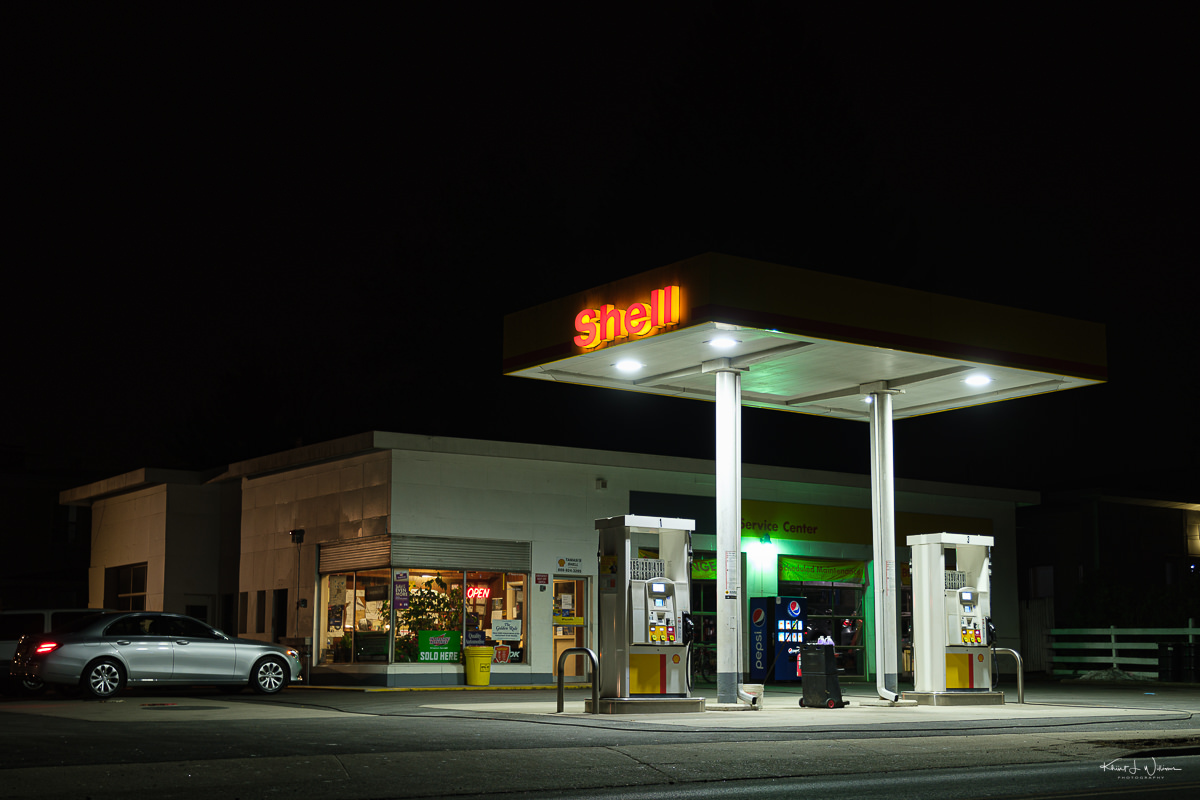
Brightly lit beacons in the night, convenience stores stood open to serve the needs of whomever might decide to walk in. But convenience stores, often surrounded by darkness, became plagued by frequent attacks of unpredictable violence. Particularly vulnerable were convenience store workers, who warily stood guard behind cash registers with little means of self-defense and inadequate protection from police. Convenience store owners, workers, community leaders, and government entities all recognized the significant danger convenience stores found themselves in at night, but keeping a store continuously open required all parties to negotiate between the benefits to be made and the risk of danger at night. Despite the danger to its employees behind the counter, the lure of money to be made at night kept convenience stores open and vulnerable.
While other stores were not open for business, convenience stores attracted customers at night with longer hours. Southland Corporation, which owned one of first and most successful chains of convenience stores called Tote’m, changed the name of its stores in 1946 to highlight its favorable 7 a.m. to 11 p.m. hours of operation.Michael Kiernan, "Conveniently, 7-Eleven Sprawls Along With Suburbs." Washington Star (Washington D.C.), November 26, 1978, F12. 7-Eleven was open later than most supermarkets and catered to shoppers’ odd-hour emergencies. “They charge a little more, but not enough to offset their sheer availability at unusual hours,” wrote Businessweek in a 1965 profile on 7-Eleven. A chain executive confidently explained why his stores could deviate slightly from the standard logic of the free market: “We’d like to be competitive on all prices, but the point is that we’re open—and they ain’t.”"Snaring Sales While Others Sleep." Businessweek, November 6, 1965, 131. Though only a minority of 7-Eleven stores were continuously open in 1965, three quarters of Southland Corporation’s convenience stores were open all night by 1978. Customers were willing to accept the store’s higher prices—and its growing reputation for attracting robberies—as the price of getting what they wanted when they wanted it. “There’s a lot I don’t like about 7-Eleven stores,” said a customer interviewed for a series of articles on 7-Eleven written by the Washington Star. “They look tacky. They charge too much. They sell stuff that isn’t good for you, and they always seem to be getting robbed. But yes, I do shop there. They’re so convenient.”Kiernan, "Conveniently, 7-Eleven Sprawls Along With Suburbs," F12.
By extending hours of business into the night, convenience stores became known as particularly vulnerable targets for night-time criminals. Though the Los Angeles Times wrote in 1972 that it was rare for holdups to turn violent, “it occurs occasionally, sometimes for no reason.” In La Puente, California, one clerk was beaten unconscious with a soda bottle. Another was smashed in the head from behind and lost his left eye.James Quinn, "All-Night Store: Cheap Thug's Favorite Target." Los Angeles Times, June 25, 1972, GD1. A 23-year-old clerk was found at night beaten and unconscious by customers at a Circle K in Twin Falls, Idaho, but robbery was ruled out as a motive when no cash was found."Convenience Store Clerk Badly Beaten." Times-News (Twin Falls, Idaho), May 23, 1980, C1. In Clinton, New York, a clerk who had just graduated high school was shot and killed at point-blank range when an intervening customer startled a robber from behind while his pistol was pointed at his victim’s head.Gary Meyer, "Both Sides Now." Clinton Courier (New York), May 4, 1983, 5. By the 1980s, all-night convenience stores were widely reported as places where senseless violence was not unlikely to occur.
Those who own and operate convenience stores spoke in newspapers and magazines about robberies as an inevitable consequence of operating at night. “The profitability of convenience stores also has attracted a number of unwelcome entrepreneurs,” Businessweek wrote on the issue of holdup men. “‘We don’t like to dwell on it,’ says one chain executive. ‘We regard it as a hazard of doing business at night.’”"Snaring Sales While Others Sleep," 131. Wide windows, easy escape routes, and limited police resources in the San Gabriel Valley were pointed out by the Los Angeles Times in 1972 for leaving forty all-night convenience stores in the area vulnerable to crime and with little protection. Even though Ray Hinds was told to expect an occasional robbery when he and his wife took over as co-managers of a Stop-N-Go store, he said he was terrified the first time a man armed with a long knife demanded he open up his cash register. But “it hasn’t soured us,” he told a reporter. “It just seems to be a part of the business.” Some convenience store clerks also expressed an acceptance of violent crime as an unavoidable risk of their occupation, and one discussed his willingness to work at night despite the threat of crime. “Heck, you can get mugged sitting home watching TV,” a La Puente, California, night manager said. “Working at night is quiet and relaxing. There’s no boss around, and normally no one else around to bother you either.”Quinn, "All-Night Store," GD1.
After four women were killed in a string of unrelated murders at four different stores across western Kentucky, the Associated Press wrote an article published in 1979 that featured the experiences of night-shift convenience store workers. The arrival of night changed the experience of working at a convenience store, and played a central role in how clerks felt about their sense of safety:
By day, the 24-hour stores are filled with the salty smell of fresh popcorn. Clerks sip soda from cans and chat with customers. The atmosphere is friendly. But after dark, when business thins and the clerks are often alone, things change in that knob of Kentucky tucked under the Indiana border. The women behind the counters grow cautious and less talkative. And the telephone is always close by. . . . “I think it’s best to keep busy, [said a store worker]. But I know the phone number of the police department by heart. We all do.”Nancy Shulins, "Clerks' Killings Plague Kentucky Stores." Los Angeles Times, November 9, 1979, D10.
Fear is talked about by convenience store clerks as a basic experience of what it is like to work at night. “If you ask them, most will tell you they get frightened at times. Particularly if they have to work late at night. Especially if they’re alone,” wrote the Dallas Morning News.James Ragland, “Danger of all-night shopping lingers despite locks, caution.” Dallas Morning News, June 30, 2003. Feelings of anxiety consumed a Los Angeles Times story about a botched robbery in Garden Grove, California. Police hadn’t notified convenience store workers about a recent murder of a clerk not far from where they worked. When the workers heard the news, they spoke candidly about their fears: “None of the employees at the stores contacted Saturday had heard about the death of Hrair Kirabeit Ghazrossian, 45, but became worried after learning about it from a reporter. . . . ‘Just give them what they want, even if it’s your money,’” said a clerk. “‘Hey you can be anywhere. Look at the girl in La Habra where they cut off somebody in a car and she got beaten to death. Or when a clerk gets shot or killed for only $38. It is just senseless.’”David Reyes, “Store Clerks Share Fear Over Killing,” Los Angeles Times, September 5, 1993, 36. Other news articles describe the helpless position convenience store workers found themselves in: “Sometimes, Manjit Kaur feels like she has this target painted across the middle of her forehead. “Things are so bad, she might as well hang a sign in the window of her Mid-City convenience store that says: ‘Take the Money. Please.’” When every clerk across eight Lil’ General stores in Florida quit after a robbery, the store chain instituted a crisis counseling program for its remaining workers. “Many clerks who are robbed have feelings of shame and anger,” wrote a newspaper in Lakeland, Florida. The chain’s security director told the paper that since the counselling program, few quit after a robbery since “. . . it’s a fact of life and they’re better prepared.”Jo Laurie Penrose, "Stores Working to Make Theft Inconvenient." The Ledger (Lakeland, Fla.), March 15, 1982, B1-2.
In At Day’s Close, historian A. Roger Ekirch writes that the fear of encountering violent crime at night occupied the minds of those in the pre-modern world who spent time in taverns, coffeehouses, and shops: “Fueled by chronic poverty and social dislocation, crime posed a worrisome concern in most of the Western world . . . Moreover, as with many perils, crime appeared to increase in magnitude and ferocity during the hours of darkness.” The aggressive, violent act of robbery at close quarters have instilled a similar sense of terror as convenience store clerks would encounter centuries later: “Central to the act of robbery was the explicit threat of physical force. . . . Often, in fact, for intimidation, victims were brutally knocked off their feet before being ordered to ‘stand and deliver,’” writes Ekirch.A. Roger Ekirch, At Day’s Close: Night In Times Past (New York: W.W. Norton & Co.), 2006, 33-4. The fear of violence at night can lead to irrational reactions, writes Paul Bogard in The End of Night, a crusade against excessive artificial illumination. Though bright, night-sky-polluting security lights are seen by Bogard as a way for most people to cope with fear in the darkness, he hopes to remind his readers that fear of nocturnal violence is usually unfounded. “We forget that crime tends to be concentrated in only a few places, and most places have no crime at all,” Bogard writes. “This is especially true when it comes to the violent, personal crime that we tend to fear most.”Paul Bogard, The End Of Night (New York: Back Bay Books), 2014, 74.
Throughout the 1970s, convenience store owners responded to the prevalence of robbery by implementing security programs throughout the country. Policies were enacted to both deter robbers and prevent holdups from escalating into homicides by controlling the appearance of the stores. This effort to control the night left stores open for business, but fortified with security measures such as escape paths, increased outside lighting, store neatness, and the visibility of the cash register."7-Eleven Stores Launch Program to Cut Robberies." The Free Lance–Star (Fredericksburg, Va.), August 3, 1977, 13. Other recommendations were preventative, such as signs meant to deter potential robbers by stating that the “store has no more than $50 after dark,” and raised platforms at the front of stores for clerks “so the clerk has a height advantage, and thus a psychological advantage.”Penrose, "Stores Working to Make Theft Inconvenient," B1-2. Among physical changes made to the stores, convenience stores implemented recommendations on how clerks should behave when sensing danger. 7-Eleven’s seven-point security program gained widespread attention by the late 1970s for being developed by Ray Johnson, a convicted armed-robber-turned-security-consultant for Southland Corporation. Not resisting a robber’s demands is emphasized in employee training, and “most convenience stores have a strict policy against employees keeping weapons in the store for self-protection.”Penrose, "Stores Working to Make Theft Inconvenient," B1-2. Clerks were trained to spot potential robbers, when to make a phone call to the police obvious for a suspicious person to hear, and when a call for help should be as discreet as possible.Quinn, "All-Night Store," GD1. Though convenience stores were willing to lose small amounts of money for the safety of their workers, these policies placed the responsibility for workers’ personal safety into their own hands.
Through municipal proposals, community leaders began to protest all-hours convenience stores by the 1970s. In 1974, a holdup-turned-homicide lead public officials to consider regulating the hours convenience stores could operate. Central to the debate between municipalities and convenience store owners was the question of who had the right to control the night. A Los Angeles Times editorial declared local government had little authority to regulate a business it had already issued a permit to, and proclaimed, “Ordering market and service station owners to close early because they might be robbed could be compared to telling people that they can’t walk on the street after dark because they might be assaulted. . . . That decision lies rightly with the owners of the business.” Instead, for the benefit of residents, the editorial recommended that a more appropriate function of the government would be to keep the community safe."Hazards of All-Night Business." Los Angeles Times, November 25, 1974. An Industry, California, police captain’s solution to the problem of night time robbery suggested his helplessness in the face of an increasingly complicated problem: “They can always close their stores at night just like they used to. But I guess they don’t want to do that for profit reasons.”Quinn, "All-Night Store," GD1.
City officials’ attempts to regulate all-night convenience stores became more aggressive by the 1980s. Though deterring violent crime was a concern for regulators at odds with convenience stores, city officials seemed more motivated to protect their citizens’ quality of life than convenience store workers’ safety. The Ventura City Council’s regulations for convenience stores stipulated that no two stores could be built within one thousand feet of each other, the stores must be architecturally compatible with the surrounding neighborhood, and the stores could not have video games.Hugo Martin, “Oxnard Studies Convenience Store Limits.” Los Angeles Times, April 6, 1990, 1. In 1984, the La Canada Flintridge County Commission in California unanimously rejected an Arco gas station’s second attempt to expand into a 24-hour mini-mart. Its complaints are more rooted in managing the malaise all-night convenience stores were associated with than confronting their propensity for violence:
Residents and representatives from local clubs and churches claimed that such a market would spawn increased noise, traffic, loitering, littering and crime; that it would lower property values, set a precedent for allowing other all-night retail establishments into the city and would irrevocably alter the character of La Canada Flintridge.Roberta Nichols, "Planners Turn Down All-Night Market Bid." Los Angeles Times, January 9, 1984, GB11.
Residents of the East Liberty neighborhood in Pittsburgh opposed a developer’s plan to build a gas station, check-cashing business, and a 24-hour convenience store in 2000, stating that the development would cause traffic congestion and excessive noise to their neighborhood as well as “serve as an all-night hangout for unsavory characters.”Jan Ackerman, "An Unwanted Corner Store." Pittsburgh Post-Gazette, June 21, 2000, 20. Community leaders feared all-night convenience stores would blight their streets and draw undesirable people to their neighborhoods.
The lure of profit has caused a marked shift in what is possible at night. According to Bogard, the expanding service industry of the past two decades is keeping an increasing number of people around the globe awake and working at night. Bogard writes, “Most have no choice—their employers (from restaurants to convenience stores to factories) benefit from staying open after dark. . . . At times for our safety but more often for our convenience, millions of predominantly working-class Americans pay the price for our addiction to light.”Bogard, The End of Night, 94-5. While employment at night was largely illegal in the pre-modern era, increasingly complex regional markets brought about a significant expansion in nocturnal labor. Ekirch argues that economic need, above all else, drove laborers to work while others slept: “. . .the pressures of subsistence—not personal preference, the pace of business, or a ‘preindustrial work ethic’—drove workers to toil late hours.”Ekirch, At Day’s Close, 155-8. Exploiting the night is integral to services like convenience stores, but being open for business means that someone must be left vulnerable behind the counter.
When a study by the National Institute for Occupational Health and Safety estimated in 1991 that 100 homicides occurred in convenience stores the year before, their suggestion that working at a convenience store put workers at risk of homicide at a rate second only to taxicab drivers circulated in newspapers for the decade to come. High-level legislators, particularly in Florida, found themselves more directly at odds with convenience store operators when they attempted to regulate stores’ hours of operation and mandate more serious safety precautions. Florida Attorney General Robert A. Butterworth proposed that Florida convenience store operators who did not either install bullet-resistant glass enclosures for clerks, or staff two clerks during the night shift, should be closed from 10 p.m. to 6 a.m. Butterworth told the New York Times in 1991 that a motivation to profit from nocturnal customers left convenience stores responsible for a “terrible high number of violent crimes being committed in convenience stores. . . . they want to look attractive to bring people in to buy at 2 o’clock in the morning. They are also attractive to people who want to commit crimes.”Peter T. Kilborn, “Convenience Store Jobs: High Risks Alone at Night.” New York Times, April 7, 1991, A1.
Squabbles ensued in newspapers over the effectiveness of staffing two clerks, the unsightliness of the glass bullet-proof cages, and the inconvenience closing the stores at night would cause customers. “‘Many people don’t lead ‘Leave It to Beaver’ lives,’” a research fellow at the American Planning Association told the New York Times. “‘Town boards need to understand that people work night shifts or two jobs or they don’t have cars, yet they need to get something at the market.’”Stacey Stowe, “New Haven Debates New Limits on All-Night Shops.” New York Times, December 6, 2003, B1. Operating at night was an expectation of convenience store franchises, and convenience store owner’s contracts stipulated their operation at all hours: “That’s what the franchise is all about, and Southland won’t stand for anything less. ‘It’s the cornerstone of our business,’ said Southland spokeswoman Margaret Chabris. ‘That’s what customers expect of us.’”James S. Granelli, “Dangerous Hours.” Los Angeles Times, August 31, 1995, 1. After the New Mexico Occupational Health and Safety Bureau conducted a study finding high levels of murder, rape, and kidnappings at convenience stores, its list of recommendations were nothing that hadn’t been proposed before; among design implementations like increased lighting and de-cluttered windows, as well as mandatory safety and security training for employees, the bureau recommended that convenience stores either staff two workers from 11 p.m. to 5 a.m. or close during those hours. When the National Associations of Convenience Stores conducted its own survey in 1996, it found that the recommendations from the New Mexico Occupational Health and Safety Bureau would be ineffective and cost too much money to implement. A Southland director of operations told the Albuquerque Journal that the government should not be involved in telling store owners how to operate their businesses. Convenience stores had instead placed the fate of their stores into the hands of the free market: “Customers want to shop in a safe environment. If we don’t provide that, they will go somewhere else,” the Southland director said.Rory McClannahan, “New Report Says All-Night Convenience Stores in New Mexico Pose Safety Risks.” Albuquerque Journal, October 15, 2003.
The financial gain to be made for convenience store owners fueled the decision to keep the stores open during the dangerous hours of night. Though all involved acknowledge the problem of all-night convenience stores’ vulnerability to crime, exactly who is responsible for keeping the workers behind the counter safe is a question that remains unresolved. Convenience store operators sought to protect their stores through self-imposed safety measures and relying on the vigilance and good sense of their workers. But the corporations found themselves on the defensive when government regulations demanded they pay to hire additional workers or close their stores off from night-time business. Police proved unable to provide sufficient protection to guard these magnets of violent crime, and community leaders’ interest in curbing all-night convenience stores was more motivated to uphold their city’s standard of living than protect its nocturnal workers. Convenience stores’ uneasy colonization of the night demonstrates corporations’ willingness to sacrifice a little bit of money, and many of its workers’ lives, for the benefit of its bottom line. Despite widespread acknowledgement of the danger the night brings to convenience store workers, 24-hour convenience stores remain open for business.