Representations of Southern economy on Confederate currency
by Jordan Siden
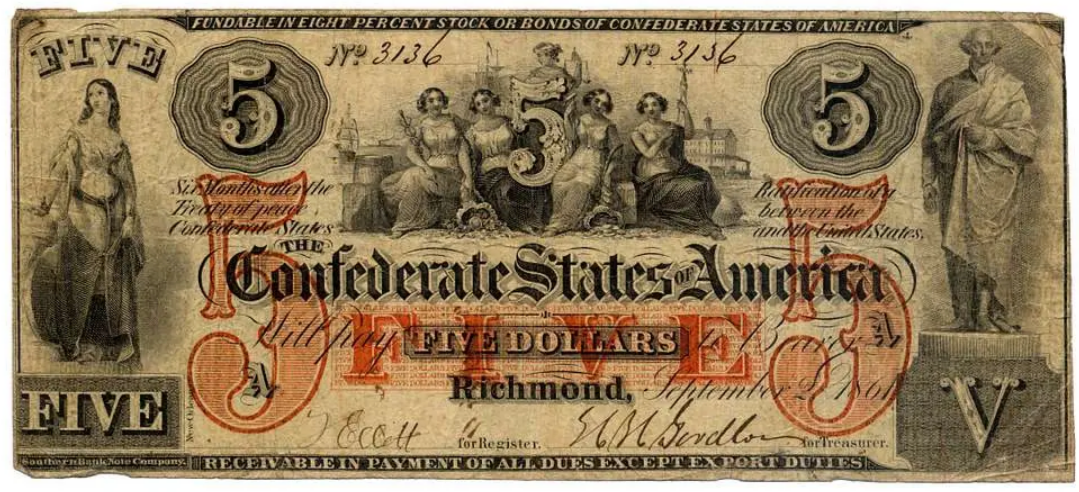
Though decades of tension had led to the moment, the Confederate States of America formed out of an eruption of swift political action. As such, the national symbols and texts of the newly found Confederacy, namely its Constitution and flags, were developed hastily in the early weeks of its foundation.Robert E. Bonner, “Flag Culture and the Consolidation of Confederate Nationalism,” The Journal of Southern History, Vol. 68 No. 2, May 2002, 293-332. Similarly, its currency developed in the midst of an urgent pressure to establish a wartime economic system. While much has been written about the Confederate economy, most studies of Confederate paper money analyze it through the context of economics, rather than as objects of intrinsic significance. Confederate banknotes, minted and distributed with much greater frequency than flags or documents, provided a legible expression of Confederate identity as manufactured in real time. Though today a cottage industry of Confederate banknote collectors has produced many catalogs and valuation guides, there exists relatively little historical analysis that examines the images Confederates used to express their national identity as a text in its own right.
Although private banks printed most of the currency exchanged in the mid-19th century, the Confederate Treasury notably printed national money emblazoned with symbolic imagery. By the conclusion of the American Civil War (1861-65), the Confederate States of America left behind a body of roughly seventy banknotes that depict a widely distributed version of its national aspirations. As document of a short-lived political entity, the images that adorn Confederate banknotes are visual texts that are invaluable for understanding a failed national endeavor. And while historians read this collection of banknotes in light of what is known about the Confederacy today, the images Confederates used to depict themselves indicated symbols of aspiration as much as they did symbols of true character.
Summarizing the history of paper money in America, Josh Lauer points out that early American money, issued primarily by independent colonial governments, was decorated mostly with symbols that would appear familiar to local exchangers.Josh Lauer, “Money as Mass Communication: U.S. Paper Currency and the Iconography of Nationalism,” The Communication Review 11, (2008): 115. Thus, Lauer writes, early American money is decorated “to invoke a sense of common identity and affiliation with local industry and commerce.” By the Civil War, much of the world had begun to nationalize its currency. Eric Helleiner describes the process as an organized and self-conscious attempt by national governments to create coherent representations of national sovereignty.Eric Helleiner, The Making of National Money: Territorial Currencies in Critical Perspective, (Ithaca, NY: Cornell University Press, 2003), 106-7. Policymakers, according to Helleiner, were well aware of currency’s visual power and social ubiquity as material that is widely disseminated and regularly exchanged. The images used on national currency could communicate images of national sovereignty to a mass audience. Helleiner writes that in an era of high rates of illiteracy, rudimentary means of transportation and communication, and weak state infrastructure, “imagery on money often provided a state with among the only means to convey symbolic messages to vast numbers.”Ibid. In addition, quoting what Michael Billing calls “banal nationalism,” Helleiner writes that the daily use of national currency reinforces symbols of collective national identity with each transaction.
Looking broadly at the full collection of banknotes issued by the Confederate Treasury, the images in total fail to convey a compelling, or even unified, narrative of Confederate nationalism. Instead, a patchwork of images can lead students of the Confederacy in a number of directions. Ian Binnington, among the few historians who has written specifically about the iconography of Confederate money, contends that the Confederacy relied on too shallow of a national identity to produce a stable visual representation of itself through its currency.Ian Binnington, Confederate Visions: Nationalism, Symbolism and the Imagined South in the Civil War, “The Pledge of a Nation That’s Dead and Gone,” (Charlottesville: University of Virginia Press, 2013), 70-92. While depictions of George Washington and Lady Liberty tie the Confederates’ secession to a revolutionary American past, these images provide only a weak sense of indigenous Southern identity. Banknotes that feature vignettes of African slaves working in cotton fields may constitute a more viable image of unique Southern identity, but as Kenneth M. Stampp contends, slavery, a divisive institution motivated by white Southerners’ “fear of a society without white supremacy,” hardly constituted an enduring national symbol.Beringer et. al., The Elements of Confederate Defeat: Nationalism War Aims, and Religion, (Athens & London: University of Georgia Press, 1988), 25. Binnington writes, “While [Confederate politicians] appeared confident in the underpinnings of their new nation—reflected both in the political certitude over the rightness of their constitutional experiment and in the bold imagery on their currency—they had actually built their national house on a foundation of sand.”Binnington, Confederate Visions, 75-6. Ultimately, Confederate currency succeeded in representing only an imagined, and unrealistic, vision of the South’s national identity.
Following Binnington’s example, this paper seeks to understand Confederate currency as a reflection of Southern identity. Depictions of industry, in the form of trains, slaves, ships, and factories make up a large portion of the collection of issued banknotes. But financial implosion, weak central government, and a lack of industrial base are understood as among the central factors explaining the Confederate defeat in the Civil War. Though a lack of consensus over specifics endures, historians of the South generally agree that economics played a significant role motivating the wartime decision-making of Southern leadership. These conflating narratives— the South’s imagined economy in light of its bleak reality—add yet another problem to Confederate currency’s function as an effective vehicle depicting a viable national image.
The economy’s generally agreed-upon role in the Confederacy’s post-mortem examination may carry over to the study of Confederate banknotes, a product whose manufacturing was as ramshackle as the Confederate economy itself. A focus on the economic aspects of Confederate identity, as represented in its currency, reveals a society troubled by monetary instability. The improvised and haphazard production of Confederate banknotes left behind a body of currency that failed to present a coherent vision of Southern nationalism. Due to poor production quality, the counterfeiting of Confederate banknotes proved to be an enormous and measurable problem for the Southern economy, and attempts to thwart counterfeiters explain the volume and variety of the Confederacy’s treasury notes. Likewise, a sort of inferiority complex may explain much of the industrial and economic iconography used throughout the many series of issued banknotes. Though the vignettes of slaves engaged in agricultural labor on Confederate currency proudly depict an image of Southern power, cultural distinctiveness, and global economic importance, this divisive feature alone could not sustain a national symbol. Though a function of currency’s imagery is indeed to inspire confidence in one’s financial system, the imagery used to emblazon Confederate money instead represented the Confederacy’s weak industrial base, volatile economy, and lack of a sustainable national character.
Even before the outbreak of war, Southerners were aware their industrial capacity was inferior to that of the North. The need to develop their economy to support the production of railways, goods and arms was well known in the 1860s. Calls upon Southern leaders to promote Southern manufacturing often stressed its importance to the improvement of Southern self-sufficiency. A year before the outbreak of the war, the Tri-Weekly Charleston Courier printed news that Calvin Cox, a North Carolinian, had invented a breech-loading rifle that could boast “equal accuracy and strength with the good old Kentucky Rifle.”“Southern Manufacture of Firearms,” Tri-Weekly Charleston Courier, January 10, 1860. The article stated, “A chance is now offered to the South to encourage the manufacture of firearms at the South, and that; too, the invention of Southern genius.” The opportunity to expand the South’s industrial capacity was to the writer a concern of regional pride.
An article written for the Baltimore American and republished in a North Carolina newspaper strongly advocated for the diversification of the South’s industrial capacity beyond cotton: “A purely agricultural State may feed its own inhabitants, but it will remain stationary . . . and make no progress in power and intelligence.” Instead, the author encouraged the South to look toward rapidly industrializing England and “imitate her example.” Without doing so, the author wrote, “we can never compete in any branch of manufacturing enterprise with the enormous capital, cheap labor and practical skill of that powerful nation.” The South, which prospered from its global export of cotton, had the potential to expand its economic capabilities in a rapidly industrializing world.“Diversifying Southern Industry,” Fayetteville Observer (Fayetteville, N.C.), August 13, 1860. This call to advance the South’s industrial capability highlighted its lack of one.
By February 1861, seven Southern states had seceded from the United States. Among the first acts of the newly founded Provisional Congress of the Confederate States, on March 9, 1861, legislators authorized the Confederate Treasury to issue its own currency in the form of treasury notes.“No. 58,” in Acts and resolutions of the first session of the Provisional Congress of the Confederate States, (Montgomery, Ala.: Barrett, Wimbish & Co., 1861), 51. This legal tender, in fact, was not initially intended for private exchange; instead of taxing the public, these banknotes were printed as the sole means of funding the impending war. From the outset, the new nation’s fiscal stability was in flux. Douglas B. Ball writes that with only a handful of low-volume engraving shops, the South had little capacity for such a large-scale endeavor: “probably for the first time in history, a government hellbent on a printing press economy was hindered in its goals by the absence of the printing personnel and materials needed for that purpose.”Douglas B. Ball, “Confederate Currency Reform of 1862,” in America’s Currency: 1789-1866, Coinage of the Americas Conference (New York: American Numismatic Society, 1985), 2. Henry D. Capers’ 1893 biography of Confederate States Secretary of the Treasury Christopher Memminger makes these constraints clear:
So exclusively agricultural had been and were the pursuits of the people of the South, and so long accustomed to depend upon the Northern manufacturers, and upon the resources of European nations, that at the very outset of his labors the Confederate Secretary found serious difficulty in providing the coupon bonds, certificates and treasury notes which were to represent the financial resources of his government. In none of the Southern cities could engravers on steel or stone be found.Henry D. Capers, The Life and Times of C.G. Memminger, (Richmond, Va.: Everett Waddey Co., 1893), 316.
Due to a lack of manufacturing capacity, the earliest Confederate banknotes were in fact produced by the National Bank Note Company in New York and smuggled into the South.Arlie R. Slabaugh, Confederate States Paper Money: A Type Catalog of the Paper Money Issued by the Confederate States During the Civil War, 1861-1865. Rev. ed., (Chicago: Hewitt Brothers, 1971), 5, 8. As such, many of the early Confederate banknotes depict borrowed icons from Northern banks. Only after the U.S. government seized its engraving plates were operations moved to a small branch of the American Bank Note Company in Louisiana. Appropriately, this small engraving shop changed its name to the Southern Bank Note Company.Ibid.
The first several series of Confederate banknotes depict an aspirational image of Confederate identity. As Binnington writes, “the images depicted on Confederate currency of 1861 and 1862 consistently presented an iconographic portrait of the South that embraced the values of commerce and agriculture, and the virtues of liberty and justice.” Concurrent with Binnington’s analysis is the large number of banknotes that depict trains, machinery, factories, and ships. The (T-5) banknote of the First Series (March-May 1861) features a central, prominent vignette of a train billowing smoke from its engine as it rounds a bend.Numismatists and collectors of Confederate currency refer to specific banknotes by their type, indicated by a “T-” and followed by the number in order which the individual banknote was published. This paper will adhere to that standard. See: Pierre Fricke, Collecting Confederate Paper Money: Field Edition, self-published, 2014, 26-7. Flanking the vignette is a female personification of Justice, and one of the goddess Minerva, the mythological Roman goddess of defensive warfare. The figures of Liberty and Minerva, Binnington writes, assert Confederate President Jefferson Davis’ sentiment in his inaugural address that history will not judge the Confederacy for the impending war.Binnington, Confederate Visions, 79. The powerful, central image of the train proclaims Confederate nation’s viability. Altogether, this banknote depicts an image that depicts a vision for the South that is independent and industriously capable.
It is striking that half of the six banknotes that comprise the First Series comprise images of trains. Though a recognizable symbol of industrial might and progress, Ball writes the South lagged behind considerably in miles of track: “The small and widely dispersed population, modest manufacturing base, and predominance of seasonal agriculture generated limited demand for rail service in most of the southern United States.”John E. Clark Jr., Railroads in the Civil War: The Impact of Management on Victory and Defeat, (Baton Rouge: Louisiana State University Press, 2001, 18. An inadequate railway network left large pockets of Texas, Florida, and Mississippi largely isolated, therein reducing their access to economic markets and products far from consumers.Douglas B. Ball, Financial Failure and Confederate Defeat, (Urbana: University of Illinois Press, 1991), 22. Due to a lack of iron manufacturing capabilities, the South relied on the North for spare parts, and damaged sections of the track were thus irreparable and useless.Robert Cook, Civil War America: Making a Nation, 1848-1877, (London: Longman, 2003), 187. All this would serve as a significant detriment to the Confederate war effort. The importance of railways to Union victory, and the South’s relative lack of maneuverability by train, is well understood as a chief factor explaining Confederate defeat.Clark, Railroads in the Civil War, 2. Due to a lack of original engravings as discussed above, images of industry might be seen simply as mimicry. But the use of train imagery is better understood as reflective of the aspirational longings of a developing nation.
While the Confederate States of America had begun to form its political institutions in the early months of 1861, calls for improving the South’s manufacturing potential became more urgent. At the outset of the war, Ball writes, the availability of resources necessary to wage a successful war effort were inferior to the North “by practically every measurable standard.”Ball, Financial Failure and Confederate Defeat, 20. Reliant on the North for heavy industry, the manufacturing capacity of Southern states was limited. Most of the goods that were manufactured in the antebellum South were “processed staples, adequate to keep only a small percentage of the Southern people clothed and shod.”Ibid. Southerners realized that the sudden creation of a precarious new nation meant the Confederacy would have to quickly work to promote industrial expansion. The Georgia Weekly Telegraph wrote in February 1861 that since the South “has determined to establish her political independence, and maintain it under a separate flag . . . it behooves her at the same time, to inaugurate a well matured and wise plan for the development of a home system of commerce and manufacture.” The article continued:
Currency, commerce and manufacturers are three of the most important constituents that enter largely into the certain prosperity and wealth of a nation. . . . It is then a matter of the first importance that the State Legislature and the Confederated Congress initiate a system of fostering Legislation that shall introduce and protect all projects for the advancement of commercial enterprise and the stimulus and encouragement of home industry. And above all, and before all, every individual citizen should, in his purchases, whenever it is practicable, give the preference to the southern importer and the Southern mechanic.“The Independence of the South,” Georgia Weekly Telegraph (Macon, Georgia), February 21, 1861, 3.
However, the Confederate States of America’s slow industrial response to the war is today well understood. The many misjudgments by Confederate President Jefferson Davis and Treasury Secretary Memminger that prevented the rapid industrialization necessary to fuel the war effort are recognized as avoidable factors that helped gradually lead the Confederacy to its ultimate demise.Ball, Financial Failure and Confederate Defeat, 7. Thus, the trains and factories on Confederate currency serve as images of an imagined, industrial South that was never realized.
As the war dragged on, the wide dissemination of Confederate currency eroded the value of the banknotes. “Paradoxically,” Binnington writes, “the more popular Confederate Treasury notes became as a form of currency and as an expression of national ardor, and the more ubiquitous they became within the Confederate states, the more they undermined the Confederate Treasury’s attempts to practice fiscal responsibility.”Binnington, Confederate Visions, 77. The Confederate Treasury released a total of seven series of banknotes, each time adding tens of millions of dollars worth of exchangeable currency into the Southern economy.Slabaugh, Confederates States of America Paper Money, 5, 9, 15, 30, 37, 41, 47. The financial policy intended to fund the war effort lead to the currency’s dramatic inflation throughout the war. A sack of salt that cost 65 cents May 1861 rose to cost $7 in October.Binnington, Confederate Visions, 78. Furthering this trend was the prevalence of counterfeiting Confederate dollars. In light of their poor production quality, forgeries were notoriously easy to produce and further destabilized and devalued Confederate currency.
The (T-14) $50 banknote of the Third Series (October 1861-September 1862) depicts Moneta, the Roman goddess of money, seated beside a treasure chest. In the distance, a train streaking past her reaffirms the central necessity of industry to the South’s prosperity. At the left of the banknote are two figures, a sailor and a machinist clutching a hammer, aboard a ship. Widely distributed counterfeits of this particular banknote produced a panic across the South in late-August 1862 when it was discovered false notes had found their way into brokers’ offices, banks, and the Confederate Treasury itself.“Counterfeit Treasury Notes,” The Fayetteville Observer (Fayetteville, N.C.), 3 Secretary of the Treasury Memminger announced that this banknote, along with two others in the issue engraved by the company Hoyer & Ludwig, were to be removed from circulation.Ibid. Banks across the South announced that they would refuse to transact in the three bills.“Meeting of the Banks,” the Macon Daily Telegraph (Macon, Georgia) September 2, 1862, 3. Days later, John Richardson, the accused counterfeiter, was hung in Richmond.“Execution of a Counterfieter,” Mobile Register (Mobile, Alabama), August 29, 1862.
Remarkably, newspapers openly critiqued the originals when they warned readers of the circulating counterfeits. The Charleston Mercury wrote that the work of the lithographer of a counterfeit five-dollar banknote was “decidedly better than that of the genuine.”“Confederate Treasury Notes,” The Charleston Mercury, September 5, 1861, 1. The Fayetteville Observer wrote that the counterfeits are unlike the genuine banknotes “in many respects, but chiefly in that they are of much superior workmanship. The figures of animals are distinct, and the etchings elegant; and it is a matter of wonder that men could execute works so superior to that for which the Confederacy is paying fortunes. . .”“Counterfeit Treasury Notes,” The Fayetteville Observer, 3. The banknotes’ iconography, easy to copy with disastrous consequence, were to newswriters an embarrassing product of shoddy, Southern workmanship. Ultimately, the prevalence of counterfeiting weakened the Confederate economy, and instilled even less trust in the unstable currency. The prevalence of counterfeiting CSA banknotes caused enormous problems to the South, and help explain the large number of variations of Confederate banknotes as legitimate printers raced to introduce new, unique, designs. Counterfeits aided to the inflation of the already weak currency, so much so that historians today recognize one individual in particular for contributing a measurable role in the Confederate economy’s destabilization.
Philadelphia businessman Sam Upham produced approximately $15 million dollars of bogus Confederate money between June 1862 through August 1863.Marc D. Weidenmier, “Bogus Money Matters: Sam Upham and his Confederate Counterfeiting Business,” Business and Economic History, Vol. 28, No. 2, (Winter 1999), 315. Economist Marc Weidenmier estimates Upham’s counterfeits constituted 1-2.5 percent of the entire Confederate money supply at the time.Ibid. Weidenmier writes that Upham’s operation began after the Philadelphia Inquirer published an image of the (T-31) Confederate banknote on February 24, 1862. Upham, a shopkeeper, noticed that he had sold an unusually high number of copies of that morning’s paper; it was the first time most, if not all, of his Northern patrons had ever seen a Confederate banknote. The Inquirer wrote cheekily that the banknote printed in that day’s two-cent paper was “worth more than the original.”(No title), Philadelphia Inquirer, February 24, 1862, 1. And though the Inquirer also wrote that the banknote was produced on paper was “of very good quality,” Weidenmier writes that Upham understood that the South’s limited capacity to produce currency made these poor quality banknotes particularly easy to copy. Upham realized he could earn a profit by producing and selling his own copies of Confederate currency. Though Upham claimed to have printed and sold facsimiles of CSA banknotes as souvenirs, his copies were notoriously easy to disguise as official state currency. While his false banknotes were stamped with an inscription to the bottom of each note that testified to their unofficial items of exchange, this inscription was easy to trim off. Instead, Upham’s disguised souvenirs-turned-counterfeits aided an entire black market operation of cotton smuggling by Northern purchasers.Weidemier, “Bogus Money Matters,” 316. To Northerners, Upham’s creation of souvenir money highlighted its importance as a visual symbol. To Southerners, Upham’s false money even further depreciated the weak currency.
Though only a minority of Confederate bills depict slaves, these banknotes continue to depict the idealized Southern economy. The (T-29) banknote of the Third Series portrays a single slave picking cotton whose expression shows only contentment and concentration. To the right of the second banknote is a scene of boat carrying bales of cotton down a river with rolling hills in the background. Though no overseer is depicted in either image, the slaves are nonetheless working in sight of the plantation house in the distance. Binnington relates these images to represent what he calls the depiction of the “Silent Slave.”Binnington, Confederate Visions, 82. He writes, “They are hard at work, without direction or supervision, and no whips, chains, shackles, or other physical manifestations of the punitive side of the institution of slavery are visible.” As humans molded into instruments of labor, slaves existed on Confederate currency beside trains and ships. These banknotes instead depict an idyllic vision of the institution that produced cotton, the South’s most important export.
To Southerners, slaves were objects of economic utility. They constituted the central engine to the South’s prosperity. In the U.S. Congress, Mississippi Rep. L.Q.C. Lamar delivered a speech in February 1860, a year before the formation of the Confederate States, responding to the abolitionist representative of Connecticut Orris L. Ferry. Lamar makes clear that the Southern planter, a figure representative of virtuous and industrious qualities, was a figure of regional pride and worthy of admiration. Lamar posited that while cotton grows in climates as far apart as Egypt, China, Spain, and both the West and East Indies, the qualities that enabled the Southern planter to “take a race of untamed savages . . . to make the finest body of fixed laborers that the world has ever seen” explained the vast industrial production of the crop to be found only in the South.Lucius Quintus Cincinnatus Lamar II, “The Slavery Question: speech of Hon. L.Q.C. Lamar, of Miss., in the House of Representatives, February 21, 1860” (Washington D.C.: T. McGill, 1860), 7-8. Planters, Lamar continued, by the names of Washington, Jackson, Taylor, Jefferson, Madison, Monroe and Polk, “acquired those qualities which enabled them, in positions in which their country placed them, to add such undying luster to the American name.” To threaten the institution of slavery, Lamar concluded, would be a “fatal blow” to the peace and stability of the United States. To Lamar, slaves are like the cotton fields themselves: centrally important commodities of the Southern economy.
The Confederacy gambled on the belief that Europe’s dependency on the Southern crop would bring about diplomatic support to the Confederacy; and indeed, slave labor provided the basis for a cotton industry that spanned the Atlantic.Ball, Financial Failure and Confederate Defeat, 63. The Daily Constitutionalist wrote excitedly in August 1861 that the British Prime Minister Lord Palmerston had remarked in the House of Commons that he had anticipated the disunion between the “two sections of the United States.”“Lord Palmerston on Cotton,” Daily Constitutionalist (Augusta, Georgia), August 27, 1861, 3. The article further contended that that the South’s export served a “growing necessity” to the cotton mills of Lancachire:
“Our agricultural industry is too important to European governments and advanced civilization, to be wholly cut off without inflicting deep injury . . . Our God-given advantage is well understood by Napoleon, Palmerston, and all European governments, who will not favour any Northern restriction of the growth of this peculiar Southern industry.”
As such, slavery, the institution that drove the Southern economy, was considered an economic necessity. The world’s dependence on Southern agriculture, the writers hoped, would save the Confederacy and bring the war to a swift close. Again, slaves were regarded as passive objects that Confederates believed would ensure their prosperity and viability.
Confederate image of slavery as depicted on its currency represented the centrality of slavery to the Southern economy. And though slavery constituted a symbol for the South that claimed its distinctiveness, it is an image that failed to sufficiently constitute a national symbol. The collaborative, historiographical work The Elements of Confederate Defeat tackles this question directly. While the authors consider the elements that may have constituted a distinct Confederate nation, they conclude, “We believe that the Confederacy functioned as a nation only in a technical, organizational sense, not in a mystical or spiritual sense.”Beringer et. al., The Elements of Confederate Defeat, 25. Citing the work of David M. Potter, the writers continue, “Much of this distinctiveness lay in the institution of slavery, which was so basic to their existence, most southerners thought that they would fight to preserve it when it was threatened.” Beside trains and ships, slaves figure as an image of Confederate economy. True, slavery existed as the one truly distinctive feature of Southern society that may have been able to constitute Southern nationalism. But as examination of the currency reveals, slaves too represented a central instrument of the Southern economy.
Currency places symbolic images into the hands of everyday people. As such, it provides a key document in understanding the image a nation chooses to portray itself. The Confederacy, a national experiment dogged by a weak economic base, ultimately crumbled. Thus, it is in both an economic sense and an iconic sense that Confederate currency was an ineffective national tool. The banknotes’ idyllic, aspirational iconography, consisting of images often directly borrowed from Northern engravers, represented a lack of true indigenous character. The rushed production of Confederate banknotes, and the ensuing prevalence of counterfeiting, resulted in a weak and undermined currency. Slavery, depicted as an instrument of the Southern cotton economy, was today and in its time considered too divisive as the sole means of the South’s distinctiveness. But though history judges these Confederate visions in hindsight, Southerners used these images to depict something else entirely. Trains represented the possibility of a self-determined future. Slaves were depicted as an object of Southern economic pride. Altogether, the discussed Confederate banknotes connect how Southerners understood themselves through their idea of their own economy. Though the Confederacy exists today only as an imagined icon, so too does its currency continue to tell a story of failed aspirations.