Spectacle, violence, and the history of NHL hockey fighting
by Jordan Siden
Now over all, and in between,
And fast as sudden thought can steer,
Our dashing cover-point hath been
Ere yet the forwards deem him near.
They charge, they check; they ply their powers
Of skill and strength—but ‘tis in vain;
He cheats them all—the goal is plain—
Shoot! shoot! Hurrah! the game is ours!
—“A Hockey Song,” Charles Gordon Rogers, 1893Charles Gordon Rogers, “A Hockey Song,” The Dominion Illustrated Monthly, March 1893, 109.
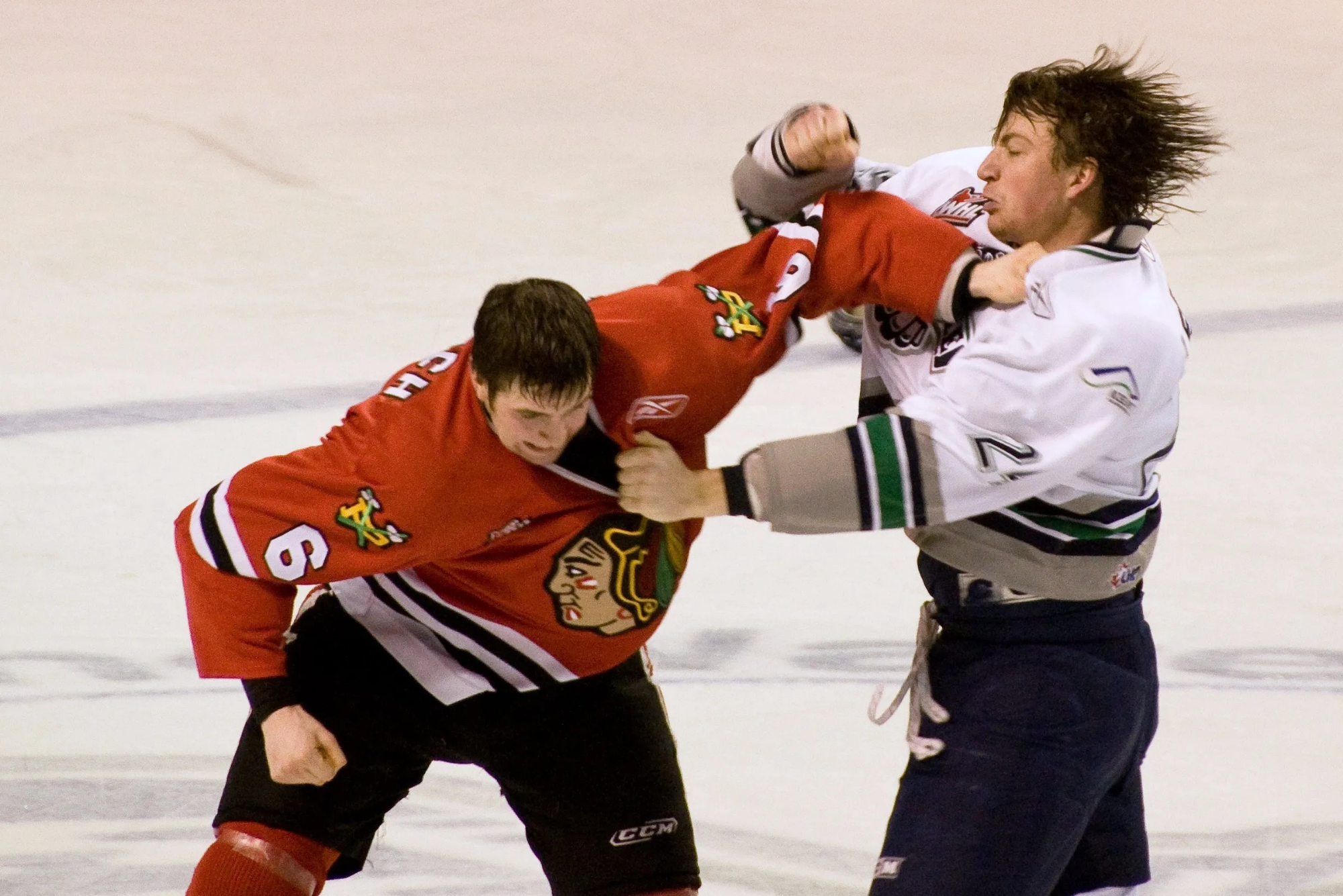
The roar of thousands of fans leaping to their feet in excitement signals the beginning of a hockey fight. Two men, each with a jersey of his own color, skate to the center of the rink. Their sticks and gloves fall to the ice and they begin to circle each other, fists clenched and raised. “Wanna go?” one shouts to the other. There are rules to this ritual. There is a method to this madness. The crowd continues to bellow as the two begin to deliver devastating blows to each other and tear at each other’s jerseys while referees stand by on guard. Once, gladiators fought to the death in Rome. Aztec sportsmen were sacrificed as holy ritual. In America, hockey players fight in front of thousands of fans and millions more watching on TV as they enact their own ritual. They fight to defend their own honor, to exact revenge for their teammates. They fight because they feel it is their duty, and they fight to keep their jobs.
American football as it is played is brutal. The ethics of Spanish bullfighting are questionable. But no sporting association tolerates acts of illegal violence like the National Hockey League, hockey’s premier professional division in North America and the world. Granted, the sport of hockey is in its nature aggressive, violent, and dangerous; within the rules of the sport, players may check each other—knock each other to their feet, or pound each other into the boards that separate the players from the fans. But the deal-with-the-Devil the NHL has made in regards to fist fighting, an activity that sports writers regularly remind their readers would any other context be considered criminal assault, makes hockey as it is played unlike any other sport in the United States or Canada. To put the problem succinctly, as Ira Gitler did in 1974, “No other sport has built into its rules allowances for combat that keep players in the game, penalizing them only for minutes at a time, rather than expelling them entirely.”Ira Gitler, Blood on the Ice: Hockey’s Most Violent Moments, (Chicago: Henry Regnery Company, 1974), 6. Though fighting is officially illegal in hockey, in practice, it exists as an expression of liminality and contradiction: to fight is to combat infringements of morality and justice in a game where the rules already allow for so much grey area.
The majority of the literature that does exist on hockey fighting is written by journalists and authors for popular audiences. While the academic disciplines of sociology and economics have assembled a noteworthy body of research scholarship on hockey fighting, to date, no scholarly book-length history has been published on hockey fighting in its own right. It means that much written about hockey fighting is anecdotal, without cited research, and sometimes only dubiously reliable. Nevertheless, hockey authors have produced magnificent histories of their own, and have eloquently described to their readers the magnificence that is to witness a game of hockey. Take for instance, Neil D. Isaacs’ tranquil assessment: “No matter how achieved, no matter what the context, a hockey goal evokes an orgasmic response that at once sends us deeper than thought within our nature and lifts us out ourselves.”Neil D. Isaacs, Checking Back: A History of the National Hockey League, (New York: W.W. Norton & Company, Inc., 1977), 22.
But while fighting can be seen as an ugly stain that marks the game on ice, its history reveals how the practice became embedded, perpetuated, and ultimately accepted as a part of how hockey is played. Exactly how hockey fighting is justified throughout time reveals much about who is allowed to break the rules in American society, and how come. From its 19th century origins and growth into an organized sport, men fought in a society that permitted violent expressions of a “passionate” masculinity. As hockey and big business linked to forge the NHL, and established hockey in the 1920s and ’30s as a modern sporting spectacle, fights on the ice drew crowds and cash while sports pages in newspapers dripped with accounts of spilt blood from last night’s matches. The NHL’s 1967 expansion turned a once elite and intimate league of players into a crowded arena of rookies willing to earn their stripes at any cost, marking a new era of brutality and intimidation as part of how the sport is played. Up until today, amid perennial scandals and deaths as result of hockey fighting, the debate over the NHL’s tolerance of violence continues with every new season.
NHL Commissioner Gary Bettman was interviewed in 2016 by reporter Maggie Gray for a video feature Sports Illustrated’s website. “Is it possible,” Gray asked, “that during your term as commissioner, fighting will be eliminated from the NHL?” Stuttering in annoyance, Bettman responded, “The context of the question is one that I don’t understand. Fighting has been a part of the game. It does act as a thermostat in the game. This is a very physical, fast-moving, emotional, edgy game . . . your question presumes that it should be eliminated, and that isn’t necessarily the case.”“Commissioner Gary Bettman fights to keep fighting in NHL,” Sports Illustrated, June 27, 2016, https://www.si.com/nhl/video/2016/06/27/commissioner-gary-bettman-fighting.
That the highest-ranking officer in the NHL condones violence, and even seems confused—or insulted—by the question, might alarm most new to hockey’s culture of fighting. But the question of just how deeply entrenched fighting is to the sport of hockey has been discussed for decades. In 2006, sports writer and motivational speaker Ross Bernstein published The Code, an investigation into hockey fighting’s culture and history. Theories behind fighting’s deep embeddedness in the sport, Bernstein writes, are plentiful: “Among them is the timeless realization that checking is an integral aspect of the game and ‘boys will be boys.’ Others include the idea that hockey, as well as lacrosse, made for great training methods in preparing young men for the battlefield.” Indeed, a sort of mystical sense of rugged Canadian idealism has been evoked before in attempts to understand hockey and its aggressive nature: “Psychologists have theorized that a combination of the long, cold Canadian winters and the Anglo-Scottish ancestry of the majority of the earliest players helped form the game as an outlet for their pent-up energies and aggressions,” Gitler suggested.Gitler, Blood on the Ice, 4.
In the introduction to his book, Isaacs summed up hockey’s early history thoroughly and persuasively. He presumed, based off an Athenian bas-relief from the wall of Themistocles depicting two men facing each other with sticks and ball, that hockey’s origins could be as ancient as 2,500 years old. Romans in the second century were also known to have played a game using crooked sticks and a leather ball. Isaacs writes that though its exact origins are still unknown, ice hockey had, by the beginning of the 19th century, been a sport firmly rooted in Canada. French explorers had in 1740 witnessed Iroquois people playing a stick and ball game in the St. Lawrence Valley, and English garrisons had imported bandy and shinny to Canada the 1830s. By the mid-19th century, it seemed that hockey in Canada had finally taken its recognizable form: “The Royal Canadian Rifles at Tete-du-Pont Barracks cleared snow from the ice in Kingston Harbor in 1867 and played an organized game with skates, sticks, pucks and goal posts,” Isaacs wrote.Isaacs, Checking Back, 23-25.
A game of ice hockey was played on March 3, 1875, at the Victoria Skating Rink in Montreal. Histories of the sport regard this organized, indoor match, made up mostly of McGill University students, as the first game of the modern sport. But while no accounts suggest players fought on the ice, mayhem in the stands ensued. The Montreal Daily Witness reported that “an unfortunate disagreement” arose after a little boy who took it upon himself to start skating in the middle of the match was “struck across the head.” A fight broke out that caused a broken bench and other damage. “It was the intention of the players to have another game, but this disgraceful affair put a stopper on it,” the article reported.“Hockey in the Victoria Skating Rink,” Daily Witness (Montreal, Quebec), March 4, 1875, 2. It is an event that has marked hockey’s deep-seated propensity to attract violence ever since. “In 1875, at the first indoor hockey game, guess what broke out?” read the headline to a 2016 this-day-in-history article in the Montreal Gazette. “There has been an infinity of indoor games since and—albeit mainly on the ice and not in the stands—an infinity of fights, too,” wrote the Gazette.John Kalbfleish, “Second Draft: In 1875, at the first indoor hockey game, guess what broke out?” Montreal Gazette, March 4, 2016.
As hockey grew in popularity across North America, excited descriptions of the burgeoning sport spread to newspapers and magazine readers in the United States and Canada. These early accounts describe hockey as a fair and fun sport: “Fouls seldom occur in hockey, because there are few openings for unfair play,” wrote Outing, an American recreation magazine, in 1898. “With the power to eject players from the game, a good referee can prevent intentional trips and strikes, the author wrote. “. . . disqualification is more or less a disgrace, and the players feel it keenly.”J. Parmly Paret, “Ice Hockey,” Outing, an Illustrated Monthly of Recreation, January 1898, 377.
Women partook in games of outdoor hockey as recreational winter sport in the late 19th century. One account in 1886 admits that though hockey was once an incidental juvenile diversion, “now the contestants are feminine and masculine in about equal proportions.”“Two Belles in a Combat,” Milwaukee Daily Journal, February 22, 1886. Some of the earliest descriptions of hockey fighting between players reveal that women were not strangers to fighting on the ice. But instead of displays of aggression, fights among women were dismissed as incidental. It seemed that at least among women, fighting was only natural in an exciting and passionate game like hockey. In a match between teams of “society women,” a “fair starter got excited” and struck at the ball before play had commenced. Though she had missed the puck, “the shin of the other starter, exposed by the short skirt of her hockey costume, got it full and hard.” A “funny fight” ensued: “In a flash the owner of the bruised and aching limb raised her own stick and welted her antagonist across the sconce. A hugging clinch was the next thing, and would have gone on into a rough-and-tumble battle had not the astounded company interfered.”Ibid. Such accounts of women’s recreational hockey, and the fights that broke out between them, seem to disappear at the outset of the 1900s, as hockey grew into an increasingly organized and professionalized sport. Across Canada and into the United States, fans at well-attended, and written-about games of hockey came to expect fighting between men.
Proponents of fighting in hockey, to this day, contend that fights constitute a “safety valve” that helps to police the already violent sport. Though the argument at first requires a negotiation of some cognitive dissonance, an account of a competitive indoor game in 1899 seems to demonstrate how players fought each other as a way to enforce the rules of the sport when the referee could not. The New Haven Evening Register described how one player, Menard, had struck Whipple with his “hockey”—perhaps shorthand for hockey stick. High-sticking was also then an offense in hockey, but though the writer conceded the hit may have been done accidentally, the infraction was “apparent to many.” Whipple retaliated, and “let out a kink in his arm” at Menard, and Roberts, a third player, had come to his teammate Menard’s defense and struck Whipple. The three “engaged in a slugging match,” which the referee, to the writer’s disappointment, tolerated. “Referee Doherty should have been fined the whole bunch a good, fat sum, but he let the matter drop with a reprimand and a foul on Whipple,” the article reported. Such a fight had no place in the sport, the writer argued, who scolded the referee for “exceedingly unsatisfactory work.”“Won from the Waterburys,” New Haven Evening Register (New Haven, Connecticut), December 27, 1899, 14.
Many accounts revealed an uneasiness with the brutal degree of violence that a hockey game could produce. One writer in 1910 decided to republish an account he had read in another newspapers. “What game is this,” the writer for Outing Magazine asked his or her readers, and quoted:
S. Cleghorn was rather impartial with the use of his stick. He landed three times on Kennedy’s ribs, once on McDonnell’s neck, and then managed to catch Jackson hard in the throat. Before Jackson fell he swung his stick at Cleghorn and catching on the head made a scalp wound four or five inches long, which had bled freely.“What Game is This?” Outing Magazine, May 1910, 252.
Both Jackson and Cleghorn got sent to the bench for a five-minute penalty. “Cleghorn announced that he would ‘kill’ Jackson when he got in the game again,” Cleghorn later earned a two-minute penalty for “slashing at McDonell.” Cleghorn went out with a vengeance: “As he retired he declared he would chop his off the next time.” More mayhem ensued. When Cleghorn, again, jabbed his stick at a player’s neck, another fight broke out: “Referee Britton pushed his way into at the crowd of players. The rooters on the side lines were shouting to their friends to ‘kill him’ and things looked bad.” After more penalties were issued, and more players took up their sticks as weapons, the writer finally returned to his question, and concluded, “No, neither a street riot not a barroom brawl. Merely a newspaper account of a game of hockey between two fairly well-known amateur teams.” Though vilified as a maniac in 1910, Sprague Cleghorn went on to become a member of three successful Stanley Cup teams, and retired with the Boston Bruins in 1927.
Explanations for why men fought in hockey games changes as societal expectations of men change. E. Anthony Rotundo writes that while America’s colonial founders once valued a masculinity more rooted in collective endeavor, by the 19th century men displayed a newfound emphasis on the importance of strengthening their own, individual bodies and allowing passion to direct their behavior.E. Anthony Rotundo, American Manhood: Transformations in Masculinity from the Revolution to the Modern Era, (New York: Basic Books, 1993) 10-11, 225. This ideal of passionate masculinity was no better espoused at the turn of the century by Theodore Roosevelt, whose “Doctrine of the Strenuous Life,” promoted such a rugged individualism. “A good American boy,” Roosevelt wrote, “must not be a coward or a weakling, a bully, a shirk, or a prig. He must work hard and play hard. He must . . . be able to hold his own under all circumstances and against all comers.”Alan Warner, The Real Roosevelt: His Forceful and Fearless Utterances on Various Subjects, (New York: G.P. Putnam’s Sons, 1910), 93.
A preference for competition marks the 19th century as a unique moment where exercise for its own sake was not enough to prove one’s manliness. Between 1860 and 1890, the competitive, organized team sports of baseball, football, and hockey all had begun to form in North America, owing their popularity “to the fact that they were competitions,” Rotundo writes. Society, in light of the Industrial Revolution and increasing urbanization, was “moving away from hierarchy and stability toward a dynamic world of individual liberty and achieved status.” And in competitive sports, to win was to assert one’s individuality and worth. By the early 20th century, men who fought in hockey rinks displayed their daring, their passion, and their allegiance to the honor of themselves and to their team. “Where strength and force were so highly valued, it was only natural that men admired fighting virtues and often endorsed violence,” writes Rotundo.Rotundo, American Manhood, 225.
By the turn of the century, as hockey evolved from its amateur roots into organized and professionalized sport, players and newswriters all begun to expect fights would break out at a hockey game. “A man who was paid to win would win at all costs,” writes John Chi-Kit Wong of hockey in the 1910s. But referees, Wong writes, were faced with the nightmarish task of negotiating a myriad of conflicting concerns from players and owners. Financial awards for winning Stanley Cups meant players would play aggressively, but rough play could also injure players, and the loss of star players could hurt gate receipts. Also, referees who were still used to hockey’s amateur ideal of gentlemanly conduct faced a moral dilemma. Interestingly, Wong says nothing about fans’ desire for violence. Rough play occupied the National Hockey Association for several seasons, and it begun to experiment with different penalty systems, Wong writes. In the 1911-12 season, a major penalty could earn players a $5 fine and expulsion from the game. But the NHA also reversed a previous policy that barred a team from replacing an expelled player. It was compromise: a team “might lose the services of the offenders for rough play,” but be able to continue playing the game competitively.Ibid.
Out of the NHA, the National Hockey League was formed in 1917. Hockey, by this point, had reached high levels of sophistication and organization, and new levels of money were flowing in to the game. The sport, had not, however, shaken it tendency to attract instances of on-ice violence. As the new league took shape, Bernstein writes how the NHL finally found compromise for its reoccurring problem of on ice fighting:
The NHL could have banned this type of violence altogether, but it chose to keep it as part of the game. In fact, in 1922 Rule 56 was introduced, which regulated but did not ban “fisticuffs,” instead giving the guilty party a five-minute penalty rather than a suspension or expulsion. The owners saw how much the fans loved the violence and saw dollar signs. Fighting and hockey were now officially joined at the hip.Ross Bernstein, The Code: The Unwritten Rules of Fighting and Retaliation in the NHL, (Chicago: Triumph Books, 2006), 4.
Bernstein’s claim pointedly implicates the NHL for violence in hockey and presents a reasonable theory for its motivation to tolerate fighting. But astoundingly, mention of Rule 56 shows up hardly anywhere else in the literature consulted for this research, including searches through online newspaper databases. Occasional mentions of Rule 56 do appear in popular articles following the publication of The Code, but more often than not without a direct citation to Bernstein’s book. The Code itself contains no citations and scant notes. Today, the NHL’s official rulebook included its guidelines on fighting as Rule 46, where it plainly lays out its preferred method for on-ice fighting, and its penalties.“Official Rules 2015-2016,” National Hockey League, 2015.
But while perhaps the NHL had officially allowed fighting a comfortable seat early in its history, an opposing force, a sort of defense against falling into a trap of being totally responsible for brutality, came into play. When British Army Officer Lord Julian Byng was appointed governor general of Canada in 1921, he and his wife moved to Ottawa, and quickly became big fans of the local hockey team. Wayne Gretzky, who recently published a popular history of the NHL, writes that Lady Evelyn Byng was known for her strict orders to her staff to not book any events for Saturday nights so she could attend Senators games. “Still,” Gretzky writes, “what Lady Byng saw often horrified her. . . . She hated to see fans throwing garbage and coins on the ice and stopping the game, and she cringed at some of the violence that was so common back then.” In 1925, after the Senators had failed to make the playoffs for the first time in seven years, Byng invited Frank Nighbor, a popular player at the time, into her office. She asked him if he thought the NHL would allow Lady Byng to donate a tall, silver cup sitting on her desk as an annual award to the player who showed “great ability, gentlemanly conduct and sportsmanlike behavior.” When Nighbor responded that they’d probably be happy to, she asked Nighbor to lift up the cup. As Gretzky tells it, she told Nighbor, “I present this trophy to you, Frank Nighbor, as the most sportsmanlike player of 1925.”Wayne Gretzky and Kristie McLellan Day, 99 Stories of the Game, (New York: G.P. Putnam’s Sons, 2016), 68-9.
The Lady Byng Memorial Trophy continues to be awarded annually to the season’s most deserving pacifist in the NHL. But the trophy could not better represent a more uncomfortable dilemma for the league to negotiate: how is the sporting organization to both applaud gentlemanly players, while at the same time condone violence? “Rewarding an NHL player for ‘gentlemanly conduct’ . . . is like honoring the year’s most modest Playmate,” spat a writer for Sports Illustrated in 2001. “Hockey players aren’t supposed to be gentlemanly, unless that means saying ‘excuse me’ before slamming an opponent into the boards.”Kostya Kennedy, “Show Lady Byng the Door,” Sports Illustrated, May 9, 2001, 76.
But despite the efforts of Lady Byng and her trophy, the arrival of the NHL to America meant that big business, hockey, and violence were about to become alarmingly intertwined. “An emerging mass consumer culture, energized by an economic boom at the beginning of the 1920s,” made the industrialized northeastern United States a potentially ripe market for professional hockey, writes Wong.Wong, 85. In 1924, the Boston Bruins became the first American hockey team in the league. The New York Americans joined in 1925 and were joined by the Pittsburgh Pirates. The New York Rangers were added in 1926, along with the Chicago Black Hawks and Detroit Cougars. The Cougars would change their names to the Red Wings, and the Americans and the Pirates would soon disappear. But by the 1946, along with the Montreal Canadiens and the Toronto Maple Leafs, the NHL would consist of its “Original Six.”
In New York, boxing promoter Tex Rickard had become interested in purchasing a hockey team as an attraction for his newly rebuilt Madison Square Garden. Even before the team had a single player, Isaacs writes, the new franchise had already been excitedly written about in the papers as Tex’s Rangers.Isaacs, Checking Back, 62. In the north, Canadian writers could feel a sense that big changes were in the works for their national sport. Hockey had drifted into the United States since the late-19th century, but never before had amassed such a large, cosmopolitan market. “For professional hockey is, first and last, a money-making affair,” wrote a writer for Maclean’s in 1926. “In New York the fans first came out of curiosity, but now they are learning the game and the Yankees, as was to be expected, considering everything, are making money right and left for Rickard.”Charles H. Good, “Will U.S. Cash Cripple Our Hockey?” MacLean’s, March 1, 1926, 13, 55. By the mid-1920s, Isaacs writes, hockey had become major winter sports attraction in New York, Chicago, Boston, and Detroit.Isaacs, Checking Back, 61.
Newspaper accounts indicate that by the end of the 1920s, the sports’ reputation for violence and aggression was eliciting an excited response from fans. Paul Gallico, a sportswriter for the New York Daily News before he became an accomplished novelist, called hockey in the newspaper a “fast, body contact game played by men with clubs in their hands and knives lashed to their feet . . . almost a certainty that someone will be hurt and fleck the ice with generous contributions of gore.”Ibid, 63-4. After a foul was called on an illegal tripper, a writer for the New McClure’s reported in 1929, “The home crowd howls imprecations, the same blood cries that were flung at the adjudicators of the day in Ancient Rome’s Coliseum.”Leslie Roberts, “The Most Dangerous Game in the World,” New McClure’s 62(2), February 1929, 20.
Fist fighting in the NHL continued throughout the 1940s, ’50s, and ’60s. And as fighting became increasingly embedded as a fact of how the game is played, aspiring young hockey players, many of whom boys growing up working-class in Canada’s periphery, knew that if they were ever to overcome the seemingly insurmountable challenge of one day skating in the NHL, they would have to become accustomed to fighting.
Gordie Howe was 14 years old when he first learned to fight on the ice. In 1942, with adults absent for the war effort, young players in town would be given opportunities to play for Saskatoon’s senior club. Howe was playing an away game in front of a hostile crowd and spit and projectiles rained onto the players. “When the home team realized they couldn’t skate with us, they decided to show a little muscle,” Howe wrote in his 2014 autobiography. A fight broke out, and the benches cleared. As fans spilled onto the ice, a veteran player pulled Howe behind him and instructed him that if anyone rushed up on the two of them, to hit the attacker on the head with his stick:
I was pretty scared, so I listened to those instructions very carefully. The scene on the ice was crazy. . . . I knew what I was supposed to do, and I didn’t hesitate. I raised my stick and cracked him on the head. Down he went.Gordie Howe, Mr. Hockey: My Story, (New York: Berkley Books, 2014), 41-2.
The teenage Howe had performed his duty. He displayed allegiance to his team and his teammates. Moments later, Howe also found out that he had knocked out a member of the Royal Canadian Mounted Police. Howe went to bed that night wondering if he would wind up in jail.
Instead, Howe went on to become one of the sport’s most seminal players. Joining the Detroit Red Wings in 1946, his career in the NHL, which spanned four decades, bridges hockey’s yesteryear to the game that it is today. A reputable fighter, his name also adorns one of hockey fighting’s most honorable achievements. In a game on October 11, 1953, against the Toronto Maple Leafs, in just one period Howe scored a goal for the Red Wings, assisted a teammate for a second goal, and got into a fight with opponent Fernie Flaman.Greenberg, Neil, “The funny thing about the Gordie Howe hat trick is Gordie Howe didn’t have many,” the Washington Post, June 10, 2016. Though a to score a hat-trick is a term usually used to describe the achievement of scoring three goals in a single game, after 1953, the “Gordie Howe hat trick” became a title given to a player who scores a point, registers an assist, and gets into a fight, all in one game. Howe himself only achieved one other Gordie Howe hat trick a year later, but his name has since become embedded into the culture of hockey fighting. One player, Rick Tocchet is considered by most unofficial counts to have achieved the most-ever Gordie Howe hat tricks, 18 accumulated between 1985 to 2000.“Career GHHTs: Rick Tocchet,” Gordie Howe Hat Trick, posted December 21, 2014, http://gordie-howe-hat-trick.blogspot.ca/2014/12/career-ghhts-rick-tocchet.html. Howe’s autobiography, however, doesn’t discuss the term.
Though the NHL had comprised of just six teams for decades, in 1967 the league began a massive expansion project that peppered the United States and Canada with new clubs across the two countries. In one year, the addition of the Los Angeles Kings, the Minnesota North Stars, the California Seals (now the California Golden Seals), the Philadelphia Flyers, the Pittsburgh Penguins, and the St. Louis Blues doubled the number of teams in the league. From 1970 to 1974, the NHL added two teams every two years bringing the total number of teams to 18. By 1979, the NHL comprised of 21 teams, only then halting its expansion until a new wave after 1991.
Like hockey’s first expansion in the 1920s following the formation of the NHL, institutional changes were felt on the ice, and the sudden bloating of the league in the 1970s formed the apex that has resulted in today’s NHL. But while its impact on fighting is without question, exactly how expansion changed fighting became an open debate among hockey writers and players. Howe wondered if the sport was no longer as tough as the days before 1967: “When there were only six teams, every player in the league came prepared to claw over his best friend the second the puck was dropped.” Before expansion, Howe writes, the NHL was an elite club of “hungry” players willing to fight to stay in. A small league meant to Howe, that there weren’t too many players on the bench any given night he didn’t have a history with: “With every NHL job being so precious, the play itself had an intensity that hasn’t been seen since. Facing each other so often only ratcheted up the potential for animosity.”Howe, Mr. Hockey, 164. Gretzky, on the other hand, wrote the opposite, claiming expansion had opened up a lot of space in the NHL for rough, inexperienced players: “Not every team could keep up with the league’s best, so that brought in more clutching, grabbing, stick work, and fighting to slow things down.”Gretkzy and McLellan Day, 99 Stories of the Game, 158.
At a Rangers game against the St. Louis Blues at Madison Garden during the 1973-74 season, the eminent hockey writer Stan Fischler said he had committed the inconceivable. After thirty-five years following hockey, Fischler wrote in the introduction to Slashing, his 1974 book, he had “committed hockey heresy,” and walked out of a game. “You won’t believe this,” he told his wife, Shirley, on the phone, “but I can’t stand this hockey game.” He wrote he was man who drove through blizzards to watch Montreal play Detroit at the Forum, who sped through the night to see minor league games in Hershey, Pennsylvania. “But that was long ago . . . that is, if you consider 1966 yesteryear. . . . Then along came expansion, and the game went to hell.”Stan Fischler, Slashing! Hockey’s Most Knowledgeable Critic Tells What Should Be Done to Save the Game, (New York: Thomas Y. Crowell Company, 1974), vii. Throughout the 1970s, a series of books published by hockey authors begun to analyze hockey fighting with varying degrees of alarm. The same year Slashing was published came Ira Gitler’s Blood on the Ice, one of the first book-length monographs on hockey fighting in its own right. Slashing, however, directly blamed the NHL’s expansion as the root cause of the sudden surge in on-the-ice violence. Fischler made the case that his beloved hockey was in danger, and he would be the one to save it. To Fischler, expansion meant that suddenly, the once elite NHL had been opened up to scores of relatively inexperienced players. It was an environment that opened up a dangerous opportunity for a new and brutal way to play the game. Fischler was not hesitant to hold the Flyers accountable for the trend, and dedicated to them an entire chapter as a case study of “total team violence.” “What has disturbed several coaches and managers is the obvious delight the Flyers take in bashing heads, bodies, and anything else,” Fischler wrote.Fischler, Slashing, 42.
The Philadelphia Flyers, among the first 1967 expansion team, had floundered in its first years. “From the very first game played by the Flyers in 1967 through the spring of 1972, Philadelphia’s NHL representative was generally likened to the ninety-five pound weakling who always is the unfortunate recipient of sand kicked in his face by the beach bully,” Fischler wrote. In particular, the more aggressive St. Louis Blues, also an expansion team, had repeatedly humiliated the Flyers with crushing defeats in the team’s first years. After the Blues had swept the Flyers four games in a row during a 1968-69 series, everyone with an eye on Philadelphia knew what had to be done. “I wasn’t angry,” Fischler quoted Flyers President Ed Snider to say. “I observed what went on during the series. It was quite simple—we were intimidated. I said to myself that would never happen to a team of mine again.”Ibid., 39-40.
The Flyers’ coordinated strategy of on-ice violence shocked the hockey establishment in the 1970s. By the 1973-4 season, a deliberate strategy to win games through muscle and intimidation turned the Flyers from an object of pity into a team feared for its brutality. Fischler writes the Flyers added a new coach, former professional boxer Fred Shero, who “understood the decisiveness that intimidation could have in a hockey game.” As hockey writers observed, the “Broad Street Bullies” were fighting on the ice as a cohesive winning strategy. “There was a method to their mayhem,” insisted Isaacs of the Flyers.Isaacs, Checking Back, 238. “It is one thing to be the only sport that tolerates fighting as ‘part of the game,’ and quite another to encourage fighting as a tactical necessity for winning.Ibid., 20. Using violence as strategy proved successful for the Flyers, who in 1974 became the first expansion team to win the Stanley Cup. Wayne Gretzky remembers his father that year worrying about the sport his son was growing up to play. “This is not good for you,” Gretzky recalled his father saying. “Now the Flyers have won, other teams will imitate them.”Gretzky and McLellan Day, 99 Stories of the Game, 70. The Flyers won the Stanley Cup again the following year.
Fischler, it seemed, had found another avenue for exploring fighting’s toll on hockey. “The 1974 world champion Philadelphia Flyers have turned butchery into a money-making art form,” wrote Fischler. “And the fans love it. Within a year after the Flyers turned killers they became the biggest drawing card in pro hockey.”Fischler, Slashing, 11. As part of his research for his book, Fischler invited psychoanalyst Ted Saretsky to a Flyers game against the New York Islanders. Fischler allowed Saretsky free range to posit psycho-social explanations that would explain the behavior of those in the stands around him: “Fights allow the audience to act out their fantasies, which is one reason why fans encourage the fighters,” Saretsky told Fischler. “Many of these fans have little control over their lives. They live in an age of bureaucracy and they don’t often get to see the little man smash the big man.” Saretsky felt that to see violence was to act out violence, a healthy outlet for the pent-up frustration of working-class life. “In a low-class society,” Saretsky continued, “violence is part of the everyday life. It’s not just capricious. In the Canadian family there’s great respect for the father, self-restraint, self-discipline, and hardiness. Quitters are weak.”Fischler, Slashing, 47-8.
Implicating hockey’s off-ice proponents is a recurring trope found in explanations for hockey violence. Indeed, from the 1970s onward, sociologists, ethicists, and economists have taken an interest in hockey’s dark side, and scholarship from each discipline has paid particular attention to fans’ role in fighting. Canadian sociologist Michael D. Smith published a paper in 1979 investigating the influence of “reference others,” or outside factors such as parents, coaches, other players and spectators, on young, amateur Ontario hockey players’ attitudes toward violence. Smith’s research described an environment where each of these forces seem to encourage fighting as normative and beneficial behavior. Smith’s wooden and removed account of a moment he witnessed might reveal his discomfort with what he witnessed: “Lobby scene following an Atom game which featured a multiplayer semi-fight (genuine fights start at about age twelve and increase with age in frequency and ferocity): two of the combatants approach a group of parents; the father of one says, smiling, ‘Looks like we’ve got a couple of scrappers.’”Michael D. Smith, “Toward an Explanation of Hockey Violence: A Reference Other Approach,” in The Canadian Journal of Sociology 4(2), Spring 1979, 115.
But fans nor parents could explain one of hockey fighting’s most enduringly remembered cases of sadism. Henry Boucha was a rising star in the NHL before he was butted in the eye with a hockey stick by Boston Bruin Dave Forbes on January 4, 1975. Before the attack, Boucha said he had had enough of Forbes “cheap-shotting” him throughout the game, and two men wound up fighting. As Boucha skated back to his bench after the two served seven-minute penalties apiece, Forbes lunged at Boucha from behind, and struck him in the eye with the butt-end of his stick. Forbes had smashed Boucha’s orbital bone. “Blood squirted out as far as eight feet onto the ice after that, and I went straight down,” Boucha recalled in The Code.Bernstein, The Code, 11-2.
After the NHL suspended Forbes for 10 games, Forbes was charged with criminal assault and put on trial. He had become the first athlete in the United States to be prosecuted for an alleged criminal act committed during a sporting event. The implication that hockey might be forever scrutinized under the law worried the hockey establishment. "This trial's a joke,” Fred Schero of the Philadelphia Flyers told Sports Illustrated. “There'd be no sports, no leagues if this kind of thing always happened. If a guy threw a baseball at your head, you'd immediately sue him.” Echoing the case for athletic impunity was NHL President Clarence Campbell, who said, “Courts are not the answer. Discipline must remain within the sport. Civil authorities are not equipped to deal with happenings in a game, [particularly] isolated incidents.” Forbes was acquitted after a hung jury forced a mistrial.Ray Kennedy, “Nondecision Begs the Question,” Sports Illustrated, July 28, 1975.
Boucha returned to play hockey, but with his once-promising career stymied. Before the injury, as a high-scoring 23-year-old, Boucha was offered a five-year contract to keep playing in Minnesota. Returning to play with serious nerve damage in his eye and trouble seeing the puck, Boucha spent the next two years hopping from team to team with meager one-year-contracts. “After only a few games with the Rockies, I just couldn’t see the puck out of that eye and had to call it a career. It was one of the saddest days of my life,” Boucha said.Bernstein, The Code, 12.
In 1980, H.R. 7903 was introduced to the U.S. House of Representatives by first-year representatives James Blachard, a Democrat from Michigan, and Republican Edward “Larry” Winn of Kansas. The bill stated that any player in a professional sports event who “knowingly uses excessive physical force and thereby causes a risk of significant bodily injury to another person involved in that event” could be fined for as much as $5,000 and, or imprisoned for up to a year. “Excessive physical force,” the bill continued, could be defined as force that “has no reasonable relationship to the competitive goals of the sport,” is “unreasonably violent,” or “could not be reasonably foreseen . . . as a normal hazard of [a player’s] involvement” in the sport.U.S. Congress, House of Representatives, Committee on the Judiciary. Hearings before the Subcommittee on Crime of the Committee on the Judiciary: H.R. 7903, Excessive Violence in Professional Sports, 96th Cong., 2nd sess., September 30 and November 19, 1980, 4. Clearly, this bill passing would mean hockey as it had been played for the past hundred years would be come to an end.
The committee had assembled a number of athletes from various sports, and among other witnesses, Henry Boucha testified before Congress regarding the career-ending hit to his eye. But as part of his testimony, he did not cover his bitterness about the helplessness he felt as a player in the NHL: “It is like being a gladiator to play in the National Hockey League. . . . they enhance the use of intimidation, different acts of violence that will sell tickets.” Boucha’s attorney, Brian Smith, added, “The other unique problem in hockey which perhaps does not exist in other sports is that violence in hockey I believe is a marketable commodity.” Echoing the hockey writers of the decade before him, Smith blamed expansion for the sudden surge in violence: “[The NHL] expanded into cities with no hockey appreciation and the clubs realized they had to sell tickets. A proven way to sell tickets was to spice up the game with increased violence and fighting.”U.S. Congress, House of Representatives, Committee, Excessive Violence, 53. Yet again, the issue of fighting had condemned the NHL for putting profits before players.
Fighting in hockey has been used an outlet for “passionate” masculinity and as a winning strategy. It has served the NHL both a revenue generator and a major liability. Though officially, hockey is made up of only three official positions—forwards, defensemen, and goalies—tough players have made their way to the NHL as unofficial “enforcers.” As Gretzky put it, during his time as a player in the late-1970s and early-1980s, “The tough guy had a role. . . . You had your offensive guys, your defensive guys and you had a couple of tough guys.”Gretzky and McLellan Day, 99 Stories of the Game, 183. An enforcer’s role in hockey rests on the assumption that it is within the players’ ability, and perhaps their duty, to enforce the morality of the fast-paced and aggressive sport when the rules cannot. “I’ll fight for the team when I feel someone else is being over-aggressive and bothering one of our guys,” minor league enforcer Brent Gogol told the Baltimore Sun in 1980. “If he knows he’s not going to get away it, he’ll stop intimidating our players.”Lou Hatter, “Hockey violence held necessary to keep foes non-violent,” the Baltimore Sun, January 27, 1980, C1. It lends credence to the idea that fist-fighting in hockey acts as a “safety valve” against considerably more dangerous brutalities such as high-sticking, cross-checking, or blade-slashing. It’s a justification for fighting as an unofficial form rule enforcement, and in a twisted way, of guarding players’ safety. “I do not find it unacceptable in a game where frustration is constant, for men to drop their sticks and gloves and take swings at each other,” NHL President John Ziegler said in 1977. “I think that kind of outlet is important for players in our games”(Title unkown), Toronto Star, December 13, 1977, C3.
Sociologist Michael D. Smith, in his 1983 book Violence and Sport, dismissed the safety valve idea as an “elaborate folk theory.” In response the NHL president’s claim, Smith retorted, “Hockey may well have its frustrating moments . . . but as researchers have repeatedly shown . . . responses to frustration are shaped by culture and learning.”Michael D. Smith, Violence and Sport, (Toronto & Vancouver: Butterworth & Co., 1983), 13. And violence, Smith claimed, is painfully easy to learn from NHL hockey. In his chapter on mass media’s effect on sports violence, Smith compiled a damning list of dozens of ways sports writers and marketers peddle hockey violence positively, including the Toronto Star’s 1983 rating of the NHL’s best fighters. Smith himself, along with two other Canadian academics, wrote to the Star and published their condemnation of the newspaper’s decision in his book. Along with a list of demanded remedial action, Smith chastised the newspaper for celebrating, “without a single word of critical distance, an activity which is prohibited by the rules of hockey and which has been shown over and over again to be injurious to the best interests of participants and the sport as a whole.”Ibid., 120.
The NHL has been forced to negotiate competing interests, and competing dilemmas. As a sports league, it is committed to upholding moral standards of sportsmanship and fair play. As an American and Canadian institution, it should be accountable for upholding American and Canadian laws. But its history of fighting, so deeply entrenched in both the culture of the sport and simply the way it is played, means that its perpetuation continues to mark the sport as one beyond the normal safeguards that protect all citizens from fear of undue harm. Until fighting becomes strictly penalized, or even subject to the rule of law, brutality and aggression will linger in the sport as a negotiation for the NHL between ticket sales and players’ safety.
Fighting, indeed, is deeply embedded into the history of the sport. Since the 19th century men and women brawled on the ice, and as the sport became professionalized, the practice became dangerously incentivized. And while armchair theorists have postulated how the rugged Canadian psyche explains the phenomenon of hockey fighting, it is hardly deniable that violence shares deep roots with the sport on ice. But when hockey violence is disassembled and examined, just how many reasons hockey players fight reveals the complexity of the practice. Hockey players fight in the heat of passion, and in personal vendettas. They fight as part of their job description. They fight to exact revenge, defend themselves and their players, and to even out uncalled cheap shots in a game. They fight to intimidate opponents and win games. But what sets hockey apart from all other North American sports is the degree of violence that it is tolerated between the lines of the rules by the NHL, the sport’s most powerful body.
Today, when a hockey fight breaks out, it plays out methodically and according to the rules: The crowd roars and the skaters meet at the center of the ice; everyone involved knows what to expect. “More often than not . . . the two combatants come out, do battle, and return to the bench, playing only a handful of minutes each game,” wrote Jim Kelley for ESPN. “It’s a dance akin to robots serving their masters . . .”Jim Kelley, “Rules reduce fighting to sideshows,” ESPN.com, January 18, 2004. As if violence has become so deeply a part of hockey, fighting seems to be no different than any other routine sporting activity expected from its players.
Fist fighting has been steadily declining in the NHL since 2008.“NHL Fights per Game, Year-by-Year,” DropYourGloves.com, http://dropyourgloves.com/Fights/FightsPerGameChart.aspx?League=1. There are signs, in the 21st century, that what is expected of the sport and its players is changing. “I really think in the next maybe ten, fifteen years, you won’t see fighting in hockey,” Gretzky wrote in 2016. “More and more guys are coming into the league without ever having fought. . . . It’s slowly being weeded out of the game.”Gretzky and McLellan Day, 99 Stories of the Game, 73. Citing increased recognition of the dangers of brain trauma, John Branch wrote in 2012 for the New York Times that even the hockey establishment has begun to consider ways to reduce blows to the head, at least in the junior leagues. “The official stance from Hockey Canada is that we want to get rid of fighting as quickly as possible,” Bob Nicholson, president of the organization, said.John Branch, “Junior Hockey on Cusp of a Revolution: Trying to Stop Fighting,” the New York Times, February 28, 2012, A1.
Fighters in the NHL behave in ways that we cannot. The men skating on the ice in the arena below, in jerseys bearing bold colors and names, perform for us in a world that is not our own. The rules that constrain our lives, history has demonstrated, do not apply to hockey players. These are men who fight, like warriors, to defend each other and put themselves on the line to defeat our enemies. But perhaps they also fight to give us the glimpse at a thrill many of us will never know. While NHL Commissioner Gary Bettman calls hockey fighting a “thermostat,” perhaps it is also a thermostat of what sacrifices American culture deems acceptable as pleasure. While comparisons between hockey fighters and the ancient gladiators can be obtuse, they also serve as a reminder to imagine how not-so-remarkable it was that Romans cheered in the stands of amphitheaters as they watched blood hit the sand. By tolerating violence as tradition, or as a safety valve, the NHL has allowed hockey to be judged on unequal terms. If hockey is so different, and above the laws of the land and of common decency, let its history of fighting be judged with scrutiny and horror.